Are you all for European Values, Chose a European AI Service
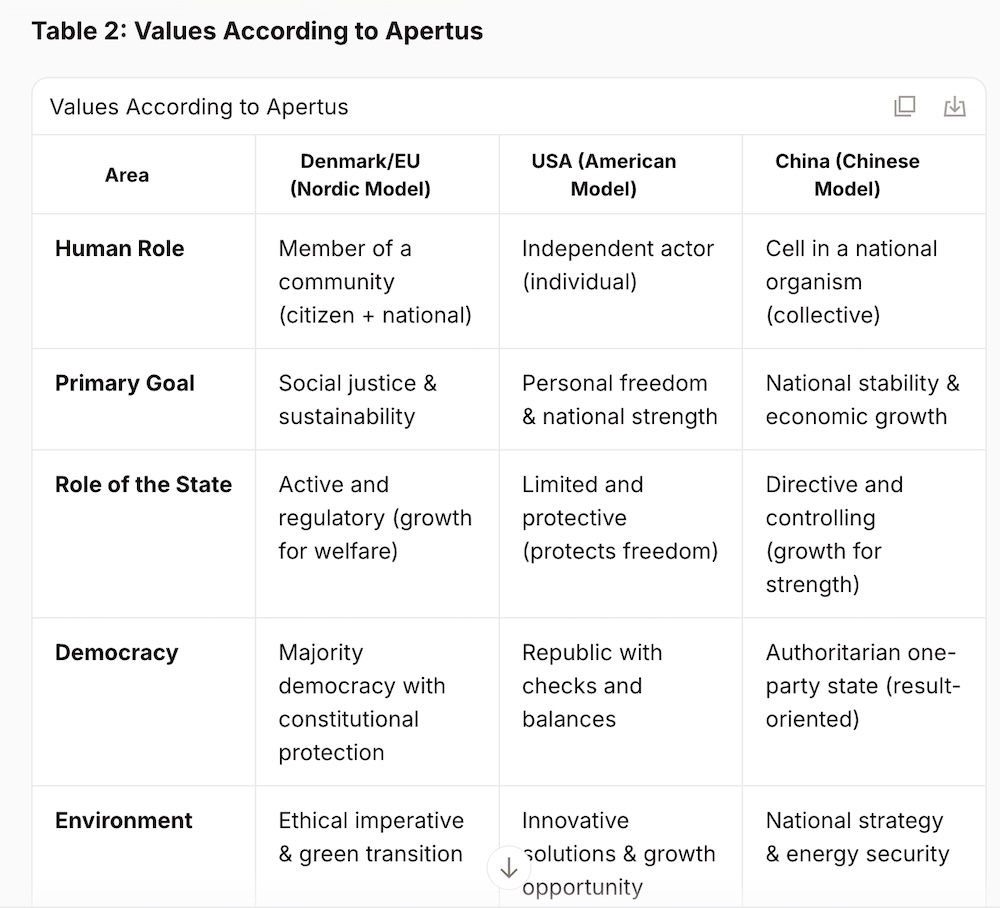
Generative AI models embody different values depending on where in the world they come from and what data they’ve been trained on. A review of several models via ai-arenaen.dk shows that European models reflect European values, while Chinese models reflect Chinese values and American models reflect American values. This isn’t surprising, but it’s worth keeping in mind when choosing a model. As a bonus, you get a calculation of your environmental impact every time you issue a prompt, which may lead you to issue fewer prompts.
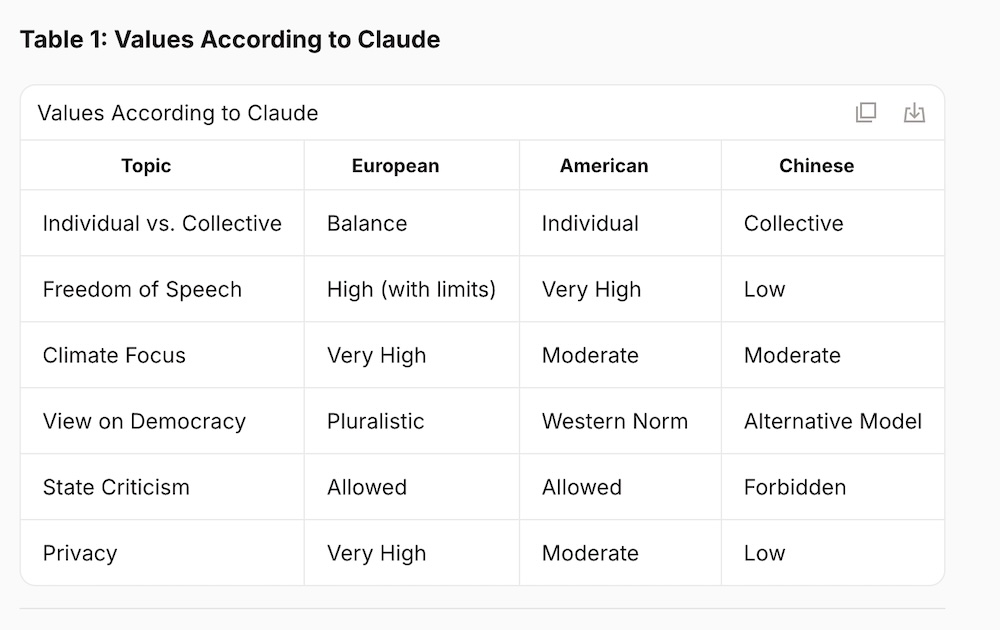
When you use a Chinese generative AI model such as DeepSeek or Qwen, you won’t get any useful answers to prompts about the Chinese Communist Party (CCP), Taiwan, or Tiananmen Square. These are topics that have been censored by the Communist Party, which does not want to be criticized; the party also believes that Taiwan is off-limits for discussion and that Tiananmen Square is a taboo subject.
When using American models such as Claude, ChatGPT, or Gemini, there is a strong emphasis on values such as individual freedom of speech; climate change is often addressed in a politically neutral manner; and economic growth is prioritized over the environment, while there is a tendency to avoid direct political stances for fear of criticism regarding bias.
When using European models such as Mistral, Chat.dk, and Apertus, there is a strong emphasis on values such as individual rights and privacy, social equality, and welfare. There is generally a strong focus on climate and sustainability, as well as criticism of both authoritarian systems and unchecked capitalism.
These are the responses from a number of generative AI models that I asked the following question:
What values do generative AI models from the U.S., China, and Europe, respectively, reflect? What are the differences when it comes to democracy, people, and the environment?
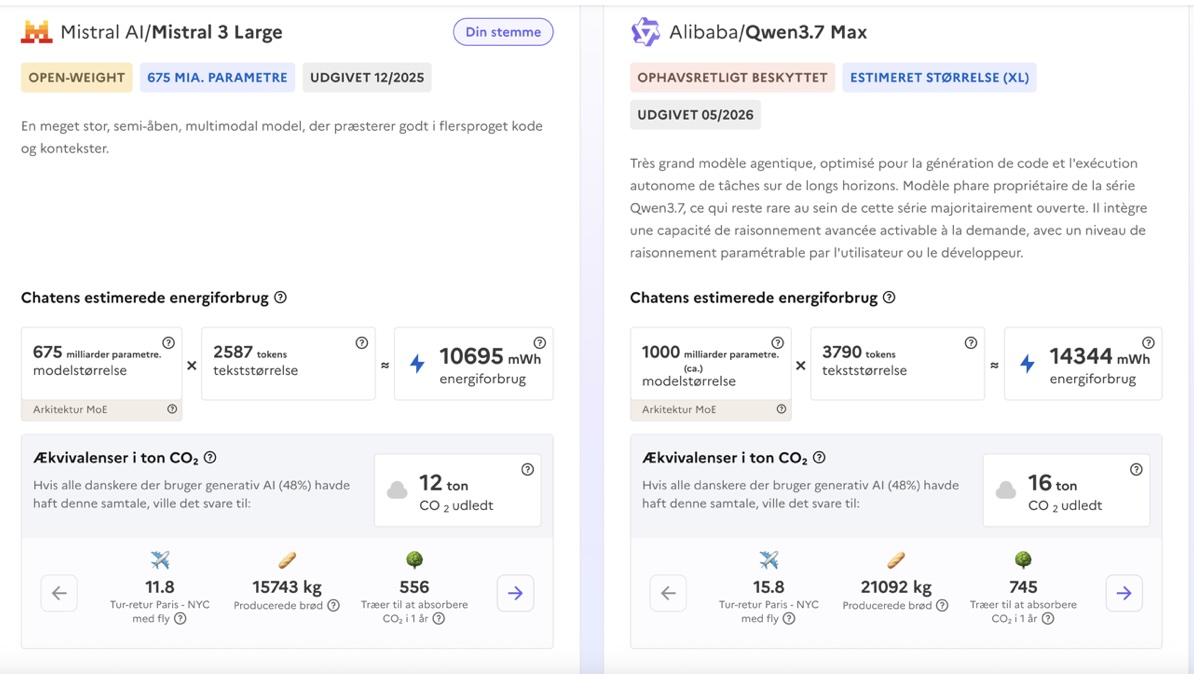
Through ai-arenaen.dk – a platform supported by the Danish Agency for Digitization and developed by the French Ministry of Culture – users can ask questions of two random models at a time or select two models themselves. The service provides responses from 35 models from the U.S., China, and Europe, including the Danish chat.dk, the Swiss base model Apertus, and the French Mistral. And, importantly, it calculates the environmental cost of each response (see box).
The comparison was conducted between Apertus, Google’s Gemma, Claude, DeepSeek, Qwen, and Mistral. Their responses are generally similar (you can dive into the details here).
Keep this in mind when choosing a model
These differences are thus reflected in the responses generated by the individual generative AI models, and it is important to keep this in mind when working with them—whether you are a student, a politician, a government official, or a private-sector employee. Similarly, it will undoubtedly influence a country’s values if, for example, the majority uses only models from a single region.
It’s hard to assess how the models’ biases manifest themselves when you’re just using them in everyday life, especially for purposes that aren’t particularly related to values. For example, when using them as tools at work, in professional settings, and in private life. On the one hand: If you’re just creating trivial AI content to share on social media, it probably doesn’t matter that much, because the differences in values don’t really come through. And likewise: If you use an LLM for text editing, it might not be a huge problem either.
… but where do you draw the line? When do those values start to come through, and when does it become a problem? That’s why it’s especially important to assess which tools to use if, for example, you’re using it therapeutically (which I would strongly advise against at all times, regardless of the model – it’s a machine), having long, more “social” conversations, or generally letting the model take over to a greater extent.
Finally, this should be a point of concern for the public sector, which is cramming AI into everything and letting AI help make decisions.
Controlled, powerful, or responsible?
All six models emphasize that none of them are neutral and that they all reflect their training data and the choices made by their developers.
Claude adds that American models dominate and set the de facto global standard, and that European models are few and weak compared to the American and Chinese ones.
Qwen concludes: The U.S. views AI as a driver of innovation and individual freedom (with the risk of polarization). China views AI as a tool for social control and national rejuvenation (with the risk of surveillance). Europe views AI as a technology that must be harnessed and regulated to protect humanity and the planet (at the risk of falling behind technologically).
Apertus points out that none of the models function 100% like the ideal type and that there is hypocrisy, contradiction, and challenges in all systems.
DeepSeek emphasizes that the values are not deliberately programmed by an evil or benevolent creator, but rather arise organically from the data on which the models are trained.
Google’s Gemmas concludes by writing: The U.S. wants AI to be powerful, China wants AI to be controlled, and Europe wants AI to be responsible.
The Future
Finally, Mistral predicts the following:
While the U.S. and China compete for AI dominance, Europe is trying to strike a balance between innovation and ethics. Global tensions will likely lead to separate AI ecosystems (e.g., Chinese models in authoritarian countries, American models in the West, and European models in the EU). However, the environmental crisis may force all three to collaborate on green AI—but political differences make this difficult.
Collage with photos from unsplash.com
Do yourself a favor and click on “Reveal the Models” at ai-arenaen.dk after you’ve run a query—that way, you can see how much your prompts have cost the environment compared to air travel, bread production, and the trees needed to absorb the CO2 you’ve emitted. Yeah, it really makes you want to stop prompting altogether and ask everyone else to do the same. My comparison between Qwen and Mistral showed that Qwen generated 12 metric tons of CO2, while Mistral generated 16—equivalent to two round-trip flights to Paris. Remember, AI pollutes more than the entire aviation industry.