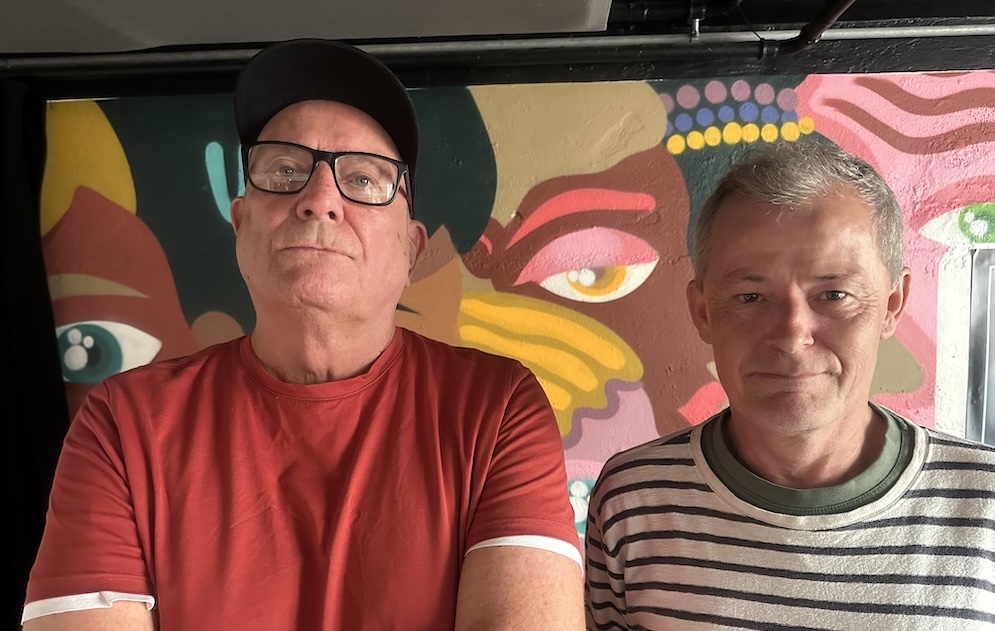
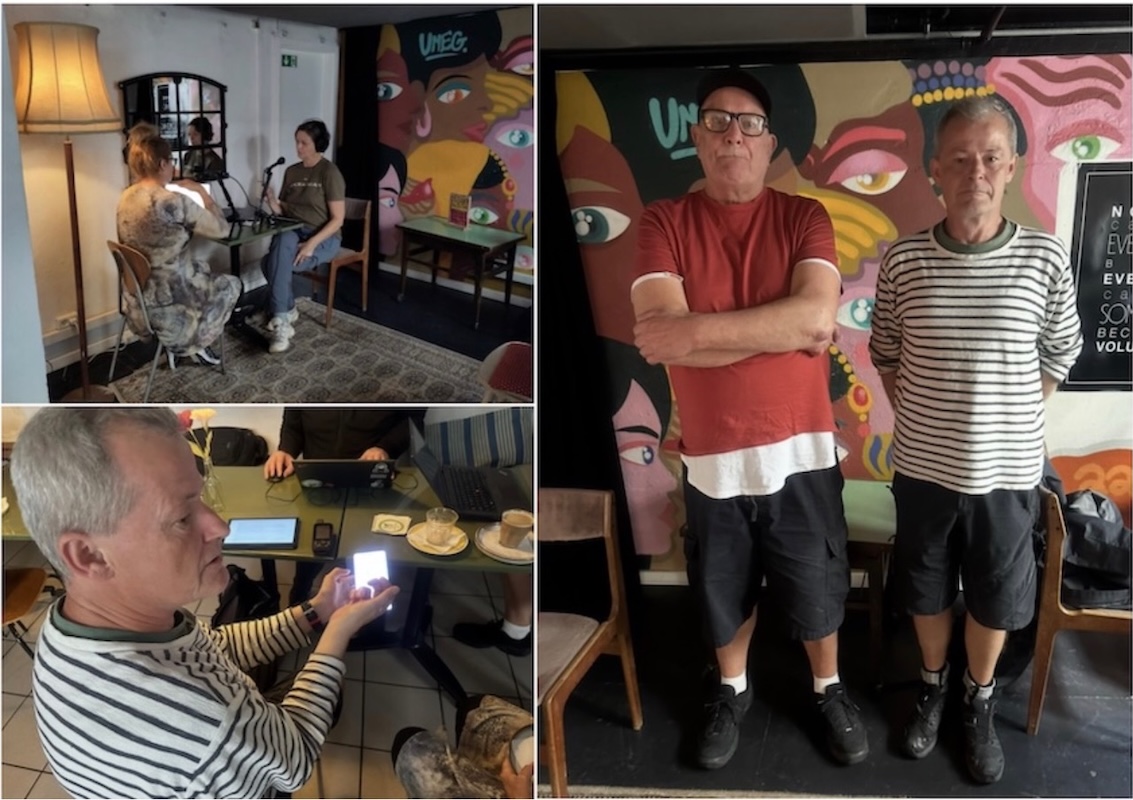
Photos: Søren Johannessen, lower left, showing how to map on his phone. Ove Larsen and Søren Johannessen right. Renée Ridgway and Pernille Tranberg upper right recording the podcast at Cafe Mellemrummet. By: Pernille Tranberg and T. Hansen.
As opposed to Google Maps, which is used by the vast majority of Europeans, OpenStreetMap is designed for citizens – not for cars, cafes, or commercial purposes. Voluntary mappers around the globe keep it updated and running as a public good.
Three minutes ago, ‘torisugari’ created a highway pass in Gwangju, South Korea. Two minutes ago, ‘Cyrille37’ created a hiking track in Centre-Val de Loire, France. Three minutes ago, someone did an update in Zanzan, Cote d’Ivoire, then someone in Berlin, Germany added content, then someone else in New York City, USA…
With Show-me-the-way, you can watch live on the website, in real time, how a mapper updates something (a place, a road, a home, a bench) on OpenStreetMap (OSM). It is like Wikipedia, run by volunteers from all over the world (approximately 20.000 from Denmark have contributed since 2004, globally it is around two million contributors), and the fascinating live-feed of a satellite picture for every update is one of the rewards mappers receive for their free contributions and viewers who follow the livestream.
It is the second Sunday of September in the autumn of 2025. We are at Nørrebro, Copenhagen, at an OpenStreetMap mapping Event at Cafe Mellemrummet.Part of the research project ’Open Source Democracy,’ we are here to find out why people spend their spare time making OSM better and how their efforts help our societies.
“Look at the commercial maps out there. They are designed by big tech and are focused on cars and shopping. That is not what most people want. They want biking, walking, and jogging routes, and also handicapped people needhelp getting around,” said Ove Larsen, former project manager, mapper, and organiser of the event in Nørrebro.
“There is no surveillance capitalism in OpenStreetMap.”
Ove Larsen
He underlines that there is no surveillance capitalism in OSM, as you are not tracked, and even if you sign in to make updates, your data is not sold.
Public Good
Renée Ridgway, who has followed the development of open source the past years, is excited to meet the OSM mappers. She calls their work a ‘public good for the world,’ and cites a quote from a Masters’ a thesis, which concludes that a bottom-up mapping approach like this can mobilise people to solve social problems all over the world.
She emphasises the human-centered approach of OSM:
“For many users, it is simply about finding the best ways to walk through the city. For example, when it is hot, people with health issues or elderly citizens can choose the roads mapped with many trees and shadows,” she says, and adds that many OSM-users don’t want to be tracked and thus don’t use Google Maps.
“Google Maps is for people driving to shopping malls.
OpenStreetMap is for communities.”
OSM motto
About Democracy
Søren Johannessen usually takes new volunteers out in the streets with the app Street Complete and teaches them how to map what is most relevant to them. Be it benches with backrests, playgrounds, or shelters (see more examples here). Often, mappers want to map their local neighborhood, says Søren Johannessen.
To him, the OpenStreetMap movement is about democracy:
“It was the same when Tim Berners-Lee invented WWW and gave it away for free to everybody. OSM is also free for everybody, and more importantly, more than 6.000 people every day map parts of the world that have never been mapped before.”
Here you can see live whenever a mapper enters something in OpenStreetMap. Video: Renée Ridgway
Søren Johannessen explains GIS: Geographic Information System is a computer-based system used to record, model, store, manipulate, analyze, and present geographically referenced data (geodata). The data is used in OpenStreetMap. Video: Renée Ridgway.
Even though Germany takes the lead in the number of Open Street Mappers (see stats here), Renée Ridgway underlines that also developing countries are represented, for example, when there was an Ebola outbreak in the Democratic Republic of Congo recently, it was mapped, and, she says that such an initiative is vital for people living there, even though they have very little financial support.
“OSM’s infrastructure is a foundation, where only one and a half person is on the payroll” Renée Ridgway says. “It is an extremely low-budget organisation with donated servers based mainly in the Netherlands. It is a truely grassroots organisation for open source making such a positive difference for so many people.”
If you want to go to a mapping event, follow the mappers at Mastodon @osmmappercph@en.osm.town and @osmmapper@en.osm.tow
Listen to episode 2: Open Street Map is For the People

Open Source Democracy is a project about why open source is important for democracy supported by Carlsberg Mindelegat. It aims to communicate the ethics and values of open source alternatives to big tech structured by three overarching topics, education, mobility, information. All articles and podcasts will be freely available at dataethics.eu/opensource