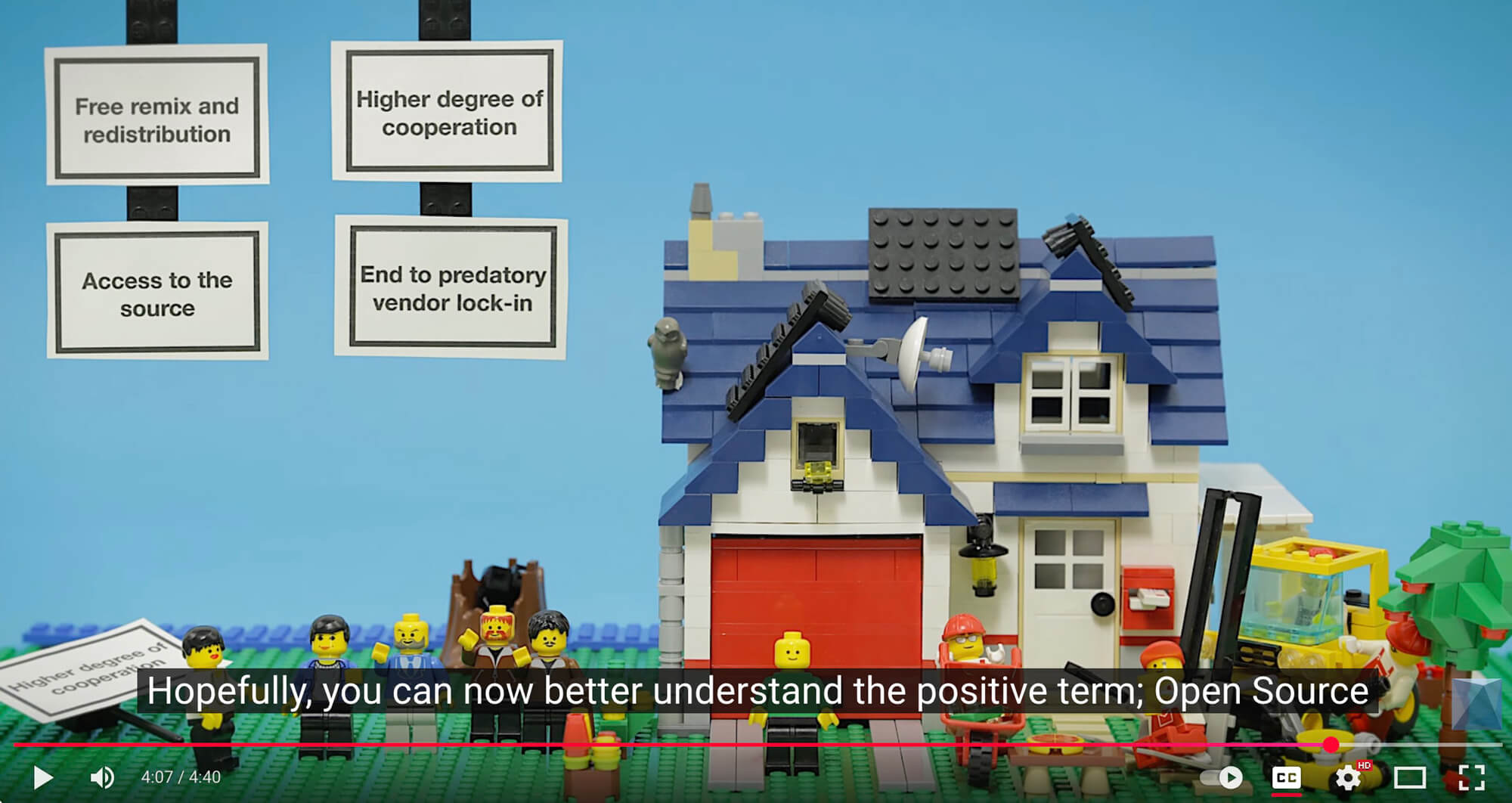
Photo: A screendump from Open Source Explained in LEGO
Europe is embracing open source technology as opposed to Big Tech’s often closed silos. But is open source the opposite of commercial? What is it, and what tools are we using in this Open Source Democracy Project?
Open source has many names. OSS (open source software), FOSS (free open source software) and FLOSS (free, libre, open source software), and Free Software, promoted by Richard Stallman at MIT. Over the years – and a lot of arguing between some of the founders of the movement – we take the liberty to call it open source tech.
The term open source usually refers to the source code that is freely available for modification and (re)distribution. It also includes values such as open, free and transparent. When Bruce Perens in 1997 published the first manifesto of open source, the Debian Free Software Guidelines (DFSG). it also included values like integrity – and no discrimination allowed against persons or groups – including those who commercialised the code.
Together with Eric Raymond, Perens founded the Open Source Initiative in 1998. Other early names in the movement is Christine Peterson who coined the term, and Linus Thorvalds who developed the first open source operating system, Linux.
The past two years, Renée Ridgway, researcher at Århus University, has been interviewing software developers, self-proclaimed ‘geeks,’ and computer programmers about how open source tech is important for democracy:
“Open source (or F(L) OSS for some) consists of people who enact care. It enables participation and sharing, and it reflects not only a technology but human activity, in short, an entanglement of knowledge, society, and politics.”
For years, many European countries have praised open source tech as an alternative to Big Tech’s closed and opaque silos. In Germany, open source is part of the country’s digitalisation strategy.
In the wake of Donald Trump’s second term as president of the United States, the European embrace of open source is becoming more pronounced with terms like ‘digital sovereignty’: We must have the right to our data (and protect its usage) and our code (to decide how it should be made accessible to others, under which open source licence).
In the summer of 2025, the European Commission published a strategic roadmap titled The Open Source Way to EU Digital Sovereignty and Competitiveness. The document proposes and details an action plan aimed at positioning open source software as a central pillar of Europe’s strategy to strengthen its technological autonomy from non-EU players.
Criticism and Embrace of Big Tech
During recent years, Big Tech has often criticized the open source movement. Back in 1975, Bill Gates called Free Software the ‘piracy problem’. From the 1970s through 2000s under CEOs Bill Gates and Steve Ballmer, Microsoft viewed the community creation and sharing of communal code, later known as free and open source software, as a threat to its business model, and both executives spoke out negatively against it.
Others have sown seeds about open source not being secure enough and that the model inhibits making money. But this criticism has become almost muted, as Big Tech has also adopted open source as part of its business model. Most often, however, Big Tech companies build on open source code and then make the products and services proprietary. A case in point is from one of Renée’s interviewees:
“Amazon Web Services, a multibillion company, is built on open source, yet has a permissive licence. They take it [code] and made it proprietary. It is extractive capitalism […] If you want it back, it will cost you every month.”
In the 2010s, Microsoft started to open source some of its code, made investments in the Linux development, and later bought the largest host for open source project infrastructure, GitHub, which caused much controversy within the community.
Walk the Talk
Instead of just words, in this Open Source Democracy research project, we try to walk to talk.
We collaborate in Proton Docs, an alternative to Google Docs focusing on privacy, transparency and open source technologies and we pay for it (around 45€ a year). The podcasts are edited in Audacity, which is free for everybody to download. We communicate via the non-profit and encrypted messaging app Signal as opposed to the vast majority in Europe using either Facebook’s WhatsApp or Messenger with their data located on Meta’s servers and metadata exposed. To us, open source tech really is a realistic alternative to Big Tech’s services that works and is safe and secure.
In Denmark universities and most of the public sector are using Microsoft, which is a closed silo. What are the alternatives apart from Proton Docs?
“I use Nextcloud in two European-funded projects I am involved in. One is OpenWebSearch.eu, which has built an open index of the web and the other is NGI (Next Generation Internet) Search project, where I worked as a Post-doc,” said Renée Ridgway, who believes the European public sector needs to better understand the benefits and adopt as much open source tech as possible.
Nextcloud is a fully open-sourced, on premise content collaboration platform. Teams can access, share, and edit their documents, chat, and participate in video calls and manage their mail, calendar, and projects across mobile, desktop, and web interfaces.
Now, when it comes to open source, let’s hope that many of the European plans and aspirations will also translate into concrete actions. In a recent lawsuit, Nextcloud complained to the European Commission about unfair bundling from Microsoft and eventually gave up because of four years of passivity from the Commission. This is surprising and disappointing. Instead, we hope to see the EU commission leading the way, and e.g. adopt European open source tools such as Nextcloud and informing citizens that there is a choice when it comes to technologies we need to use.
Listen to episode 1: What is Open Source.

Open Source Democracy is a research and communication project about ‘Why open source is important for democracy – the ethics and values of European alternatives to big tech’. It is funded by a Carlsberg Mindelegat. Find it all on dataethics.eu/opensource