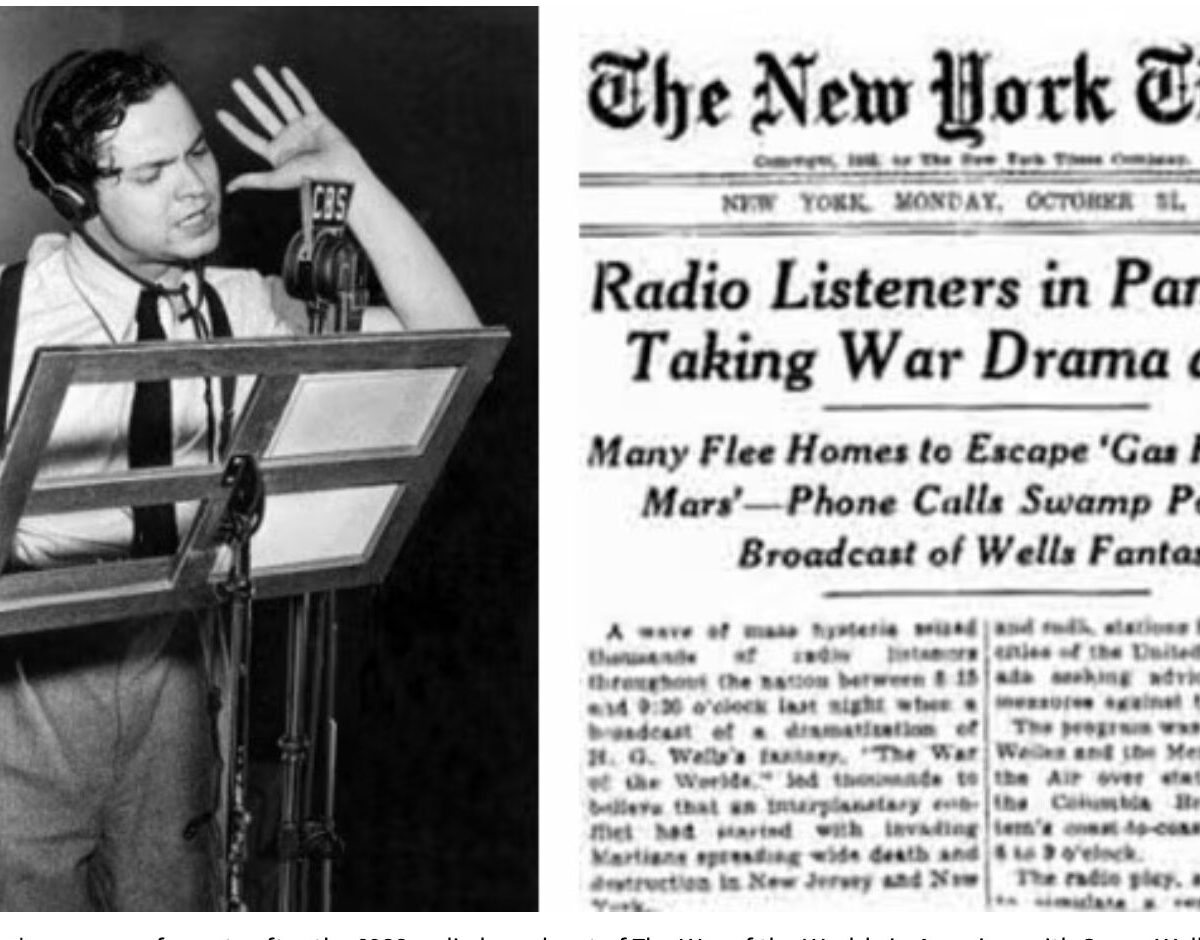
In 1938, Orson Welles’ radio drama “The War of the Worlds”, introduced with realistic news bulletins about a Martian invasion of Earth, caused panic among some listeners who thought it was real. Some left their homes, others called the police terrified of the alien attack. The show was introduced as a fictional radio drama. Nevertheless, when listeners tuned in later in the programme all they heard was the news bulletins. And the Martians were arriving. Fiction became reality.
It was world war times. People were alert, nervous about the future, their existence. Times were changing. Radio broadcasts were also carrying documents of this uncertain reality across the Atlantic.
The human experience is always exposed and easily manipulated.
This example of Orson Welles’ radio version of the War of the Worlds is often used to illlustrate clashes between emerging technologies/mediated communications and human experience. The impact of electronic and digital media on human communications, the ethical standards, the signals and cues we learn to interpret and our expectations. The no 1 rule being that the pace of media transformation, their impact on the basic rules of communications, need to be in tune with human experience.
This time I used the example for an interview for an article in the Danish newspaper Politiken by Fiona Fälling about a flood of AI generated videos – so realistic that tourists travel to places that turns out not to exist, police show up at fake terrorist attacks, and we are really, not just for a short moment, but consistently starting to doubt what is real and what is not – and sometimes we even ask: Does it even matter?
It does. Because this is not a joke, a quick prompt or a novel sci-fi story gone rouge. Not a “healthy” wake upcall that there is no truth and nothing can be trusted.
It is a loss of control.
In history, its always been like this. The moment when citizens loose the shared benchmarks regarding what, who and when to put trust in information, they loose agency and the only option is to return to the “authoritative” source of information. The backpacker basically becomes a helpless charter tourist.
Today we all need to act like investigative journalists, as I say in this article, and eventhough critical alertness of citizens is crucial to a well functioning democracy, the transformation is too abrupt. And this disruption is way too much to ask from citizens, as Copenhagen Business School professor Mikkel Flyverbom, who was also interviewed for the article, says.
Listen to Orson Welles’ 1938 radio drama here
Read the Politiken article in Danish
“This is Orson Welles, ladies and gentlemen, out of character, to assure you that the War of the Worlds has no further significance than the holiday offering it was intended to be. A Mercury theatre’s version of dressing up in a sheet and jumping out of a bush and saying boo!…”