Six Charming European Chatbots
If you follow the news coverage of AI and chatbots, you might get the impression that there are only three or four players, all of them American. But why miss out on these six charming European chatbots?
Before we look at them, it is worth reconsidering the criteria we use to measure the success of chatbots.
If we focus solely on complexity and speed/volume, Claude, Perplexity and ChatGPT are considered the best. If we look at criteria such as digital sovereignty, data control/privacy and GDPR (i.e. compliance with EU legislation!), Le Chat and Lumo come out on top. If you’re a day trader or a developer, the European models might not give you a competitive edge, unless your customers actually see digital sovereignty, data control, and ‘buy European’ as an advantage. For the vast majority of us mere PC users, the European models are quite excellent.
Generally speaking, I’m not too worried that our technology has some intended obstacles. Speed isn’t always the answer if the price is the right to privacy, flouting the law, or failing to take responsibility for the significant environmental costs associated with a product and its use. Consider Dogme films and New Nordic cuisine, which have led to global innovation in film and gastronomy. In the same way, we should not fear ‘obstacles’ or ‘speed bumps’ such as privacy and digital sovereignty. Hopefully, this can unleash new innovation, where AI helps to make the world a better place, gives us a better working environment, better health and more time for the things that give life value (which, for most people, is not staring at a screen).
One might also ask: What is the best narrative for your own and your company’s use of chatbots? Is it to support the future that Sam Altman, Jeff Bezos, and Elon Musk wish to create, or is it a future built on European values, where we look after our children, our democracy, and our planet? It’s a classic David versus Goliath situation, and here I’m rooting for Team David.
So before you write off European chatbots because of all the hype surrounding American or Chinese models, give them a try and see for yourself.
The Six European Chatbots
1. Le Chat from the French company Mistral is the most widely used European chatbot. The name means both ‘cat’ and ‘chat’, and that alone might be enough to win you over. Mistral can also be used for AI agents. Studies comparing Mistral’s model with US and Chinese, find that it reflects European culture and answers with “cautioned respect for cultural and historical factors.”
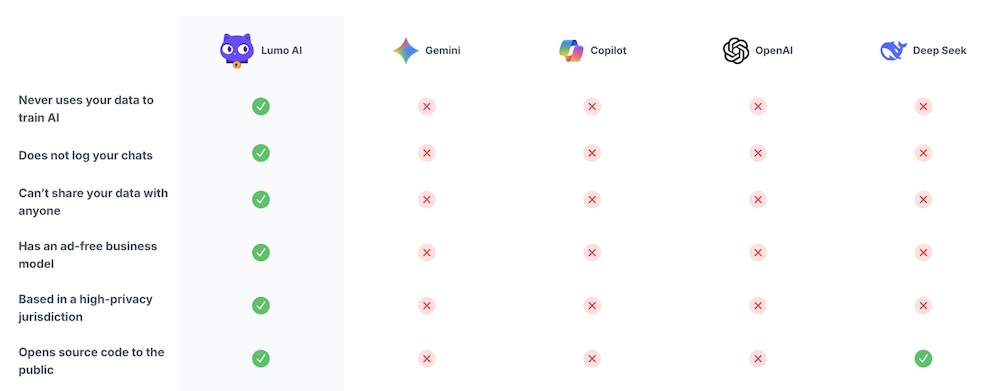
2. Lumo from the Swiss company Proton places a strong emphasis on privacy and security. It does not log chats, and all prompts are encrypted. It is also open source; ‘Unlike other AI assistants, my code is fully open source, so anyone can verify that it’s private and secure — and that we never use your data to train the model.’
3. Chat.dk from Ordbogen.com is a fully Danish model: “The solution is run from a Danish data centre with a focus on secure data storage and compliance with Danish legislation.” It is free for schools and can be downloaded as an app. I have used it quite a bit myself and am very satisfied with its results. It is sometimes a little slow to respond, but that might mean you think a little more carefully before firing off a prompt. Their ambition is to be the best in Danish, but it does speak English and most other languages as well.
4. Ecosia AI from German company Ecosia plants trees with its profits. In 2025, they reached their goal of planting 230 million trees and are now looking into other climate-related initiatives. Ecosia is best known as a browser and search engine but has added a chat function. All profits go to a fund. They have a number of partnerships with big tech (Microsoft, OpenAI), so you should choose this one based on their climate contribution.
5. Apertus from Public AI is a Swiss chatbot, open-source and non-profit: ‘We believe in public AI—AI as public infrastructure like motorways, water, or electricity. Think of a BBC for AI, a public utility for AI, or public libraries for AI.’ It can write in Swiss German, which has its own unique charm for the approximately 6 million people who speak it.
6. Thaura.ai is also German and describes itself as ‘the ethical AI alternative to Big Tech – we’re decentralising AI so power goes to users, not corporations that exploit them.’ It is open-source and has no ties to big tech.
Five Chatbot Pitfalls
With the shameless promotion of chatbots, I feel compelled to highlight some of the many pitfalls that thoughtless use of chatbots can entail. Just because the chatbot “can think for you”, you shouldn’t switch your brain off.
1. For businesses, there is a risk in becoming too dependent on a single AI provider, which can then drive prices up. We have seen this with enterprise software, and it stands to reason that AI companies will do the same. When prices rise, it is a good opportunity to assess whether you are actually paying for a solution that you are not utilising to its full potential.
2. AI sloppiness and overproduction (content pollution) is another pitfall that is already plaguing our working lives. People are producing poor reports, texts, and products using AI, which then take a long time to sort through or correct. ‘It’s just a draft’ – sure, but don’t waste other people’s time with AI drivel. Similarly, you risk producing too many reports and too much content that no one has time to read. The principle of ‘less is more’ should also apply to AI-generated content.
3. AI consumes significant amounts of energy and water, not to mention the fact that data centres are springing up everywhere. The company’s AI strategy (which in many places boils down to ‘prompt, prompt, prompt!’) must align with its ESG strategy.
4. False data and dangerous advice are called ‘hallucinations’, but that sounds too cute; they are, after all, lies and manipulative behaviour, often intended to bind the user more closely to the chatbot and thereby increase usage. There are many examples of this; for instance, chatbots provide problematic health data in 50% of cases, according to a scientific study. If you write the first draft yourself or have read a report you want to make a summary of, it is not so hard to fact-check.
5. GDPR and other legislation, such as copyright, are not enforced very well towards the American tech giants. As the examples above show, several of the European chatbots focus on ensuring that legislation is complied with and that users’ privacy is safeguarded.
Illustration: This is made by Mistral with the prompt: Make an illustration of a charming chatbot